
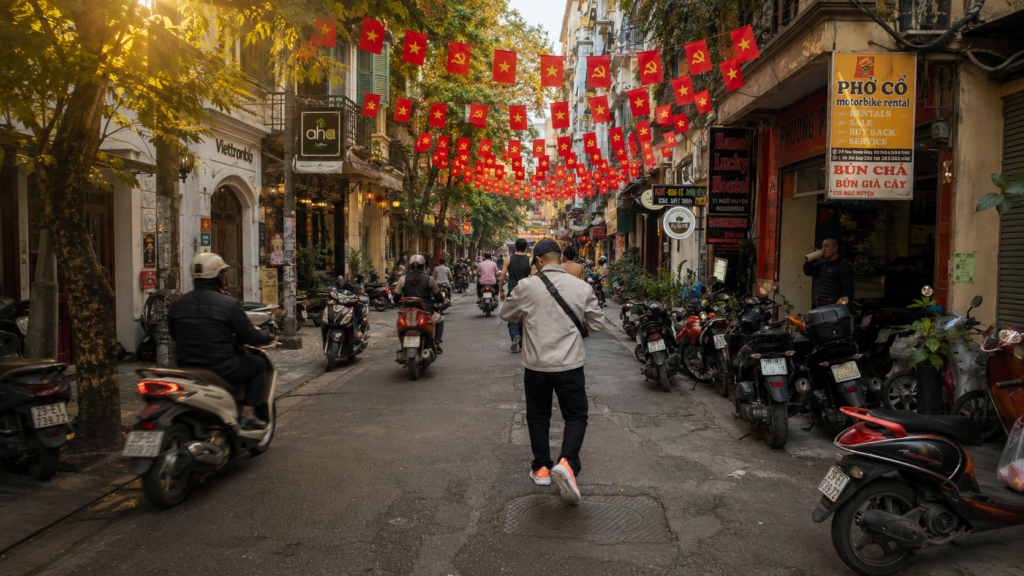
Hanoi spreads along the western bank of the Red River in northern Vietnam, its Old Quarter a tangle of streets each still named for the single trade once sold there — silk on Hang Gai, silver on Hang Bac, paper on Hang Ma. The city’s name itself, Hanoi, translates roughly as “between the rivers,” a nod to its position cradled by the Red River and its tributaries at the edge of the Red River Delta.
Hanoi traces its founding to 1010, when King Ly Thai To moved his capital here and renamed the settlement Thang Long, “Ascending Dragon,” after reportedly seeing a dragon rise from the riverbank. Centuries of dynastic rule followed, interrupted by periods of Chinese occupation, before the city became the administrative capital of French Indochina in 1902 and, eventually, the capital of unified Vietnam in 1976.
That layered past is still visible on the street: French villas with shuttered windows stand a block from Soviet-era apartment blocks, and centuries-old temples share pavement with glass-fronted coffee chains. Hanoi moves at the pace of its motorbikes — fast, dense, and a little chaotic — yet its lakeside mornings remain unhurried. The rest of this guide breaks down exactly how to navigate that contrast.
Is Hanoi Worth Visiting?
Yes — Hanoi rewards visitors with one of Southeast Asia’s most distinct food cultures and a historic core still genuinely lived in rather than preserved behind glass. Its appeal lies less in single blockbuster sights and more in the texture of the place: a thousand years of history compressed into streets where a bowl of pho costs less than a coffee back home.
Hanoi is great for:
- Street food obsessives who want to eat their way through an entire city
- History and architecture fans drawn to French colonial buildings and ancient temples
- Travellers using the city as a launchpad for Ha Long Bay, Ninh Binh, and Sapa
- Budget-conscious backpackers, since accommodation, food, and transport all run cheap by international standards
The honest downside: traffic is relentless, pavements often double as parking or motorbike lanes, and crossing the road takes a few days to get used to. Visitors who can tolerate a bit of organised chaos will find Hanoi one of the more rewarding capitals in the region — the sections below cover exactly when to come and how to spend the time once here.
Best Time to Visit Hanoi
Peak Season (October–November)
Autumn brings dry, comfortable weather — daytime highs of 27–31°C, low humidity, and rainfall dropping sharply after the summer monsoon. It’s the easiest stretch for sightseeing on foot, with manageable crowds at the Ho Chi Minh Mausoleum and Temple of Literature, and clear skies for a Ha Long Bay side trip. There’s no major festival in this window — the appeal is purely Hanoi’s best weather of the year.
Shoulder Season (February–April)
Late winter fades into spring with mild highs climbing from the low 20s to around 30°C, though February and March often bring drizzle and the low-lying mist locals call “mưa phùn.” It’s a budget-friendly window with thinner crowds than peak season, though the hazy light suits atmospheric photography more than blue-sky shots. The Perfume Pagoda festival runs January through March, and some northern pagodas reduce hours during festival upkeep in February.
Off-Season to Avoid (May–September)
Summer turns genuinely uncomfortable, with highs regularly hitting 33–35°C, high humidity, and a July–August monsoon bringing frequent afternoon downpours that can flood the Old Quarter’s lower streets. It’s the toughest stretch for comfortable sightseeing, though hotel rates drop and day trips to Ha Long Bay and Ninh Binh carry a higher risk of weather disruption. Reunification Day (30 April) and Labour Day (1 May) bring a domestic holiday rush right at the start of this season, before the quieter low season settles in.
| Season | Month | High (°C) | Low (°C) | Avg (°C) | Rainy Days |
|---|---|---|---|---|---|
| Peak Season | Oct – Nov | 27–31 | 20–23 | 24–27 | 6–10/month |
| Shoulder Season | Feb – Apr | 23–30 | 16–23 | 19–26 | 12–15/month |
| Off-Season to Avoid | May – Sep | 33–35 | 25–27 | 29–31 | 13–22/month |
How Many Days to Spend in Hanoi
Two to three days is the sweet spot for most first-time visitors — enough time to explore the Old Quarter, walk around Hoan Kiem Lake, and take in the Ho Chi Minh Mausoleum complex without feeling rushed, while still leaving evenings free for bun cha, egg coffee, and the night market.
With just a single day, focus on the Old Quarter and Hoan Kiem Lake and accept you’ll miss the rest. Four days or more comfortably adds a day trip to Ninh Binh or Ha Long Bay, or a slower pace exploring Tay Ho’s cafes and lakeside streets.
If you’d rather follow a structured day-by-day plan, our Hanoi Itinerary breaks down exactly how to spend your time.
Hanoi Itinerary for 3 Days
Three days, grouped by neighbourhood rather than by clock time — each day follows one geographic cluster on foot before moving to the next by Grab, minimising the backtracking that Hanoi’s traffic makes genuinely costly. Day 1 covers the historic Old Quarter core, Day 2 moves through the monuments and colonial French Quarter, and Day 3 slows down around Tay Ho with room to swap in a day trip if you have the time.
Day 1 — The Old Quarter & Hoan Kiem Lake
Hoan Kiem Lake & Ngoc Son Temple
Start before 9am at Pho Gia Truyen on Bat Dan Street, when the broth’s freshest and the queue’s shortest. From there it’s a short walk to Hoan Kiem Lake — a slow circuit takes about 25 minutes — before crossing the scarlet Huc Bridge to Ngoc Son Temple, a small island shrine best visited early before the lakeside pedestrian zone fills up.
The Old Quarter’s Guild Streets
Spend the late morning wandering the 36 streets, each still named for the trade once sold there — Hang Gai for silk and tailoring, Hang Bac for silverwork — before reaching Dong Xuan Market, the district’s largest indoor market.
Lunch — Bun Cha Huong Lien on Le Van Huu Street, the restaurant where Anthony Bourdain and Barack Obama shared a meal in 2016, the original table now displayed behind glass.
Hoa Lo Prison & Train Street
Head to Hoa Lo Prison in the early afternoon — the French-built colonial jail later used to hold American POWs, nicknamed the “Hanoi Hilton.” From there it’s a short walk to Hanoi Train Street on Ngo 224 Le Duan Street; check the schedule locally, since a train typically passes mid-to-late afternoon.
Dinner — Cha Ca Thang Long on Duong Thanh Street, a Michelin Bib Gourmand address built around a single dish, turmeric-marinated fish grilled tableside. Go early, since the tableside setup takes longer to clear later in the evening.
Finish the evening on Ta Hien Street (Beer Corner), the Old Quarter’s liveliest strip of plastic-stool bia hơi bars, or catch the 7:30pm performance at the Thang Long Water Puppet Theatre beside the lake for something more cultural.
Day 2 — Ba Dinh & French Quarter
Ho Chi Minh Mausoleum Complex
Arrive by 8am — the mausoleum keeps strict hours (Tuesday–Thursday and Saturday–Sunday only) and closes for roughly two months each year for maintenance. The surrounding complex includes the Presidential Palace, Ho Chi Minh’s stilt house, and the One Pillar Pagoda, a two-minute walk away.
Temple of Literature & Imperial Citadel
Continue to the Temple of Literature, Vietnam’s first university, where 82 stone stelae record the names of doctoral graduates across three centuries of imperial exams. A short Grab ride away, the Imperial Citadel of Thang Long served as Vietnam’s political centre for nearly a thousand years, including an underground bunker complex used as recently as the Vietnam War.
Lunch — a bowl of bun rieu (crab noodle soup) from a stall near the Temple of Literature, a lighter counterpoint before the afternoon’s walking.
French Quarter & St Joseph’s Cathedral
Head into the French Quarter to see the Hanoi Opera House, then continue to St Joseph’s Cathedral, whose Gothic façade is best seen illuminated in the early evening. The surrounding Nha Tho Street has some of the city’s best-preserved French-era shopfronts.
Dinner — Cafe Giang on Nguyen Huu Huan Street for Hanoi’s original egg coffee, best treated as an early-evening ritual, followed by a sit-down dinner at one of the French Quarter’s colonial-era restaurants.
Day 3 — Tay Ho (West Lake) & Onward
Tay Ho Lakeside
Spend the morning at a slower pace around Tay Ho, Hanoi’s largest lake. Visit Tran Quoc Pagoda, the city’s oldest, dating to the 6th century, then walk or cycle the lakeside path past the neighbourhood’s café strip.
Lunch — a café along Xuan Dieu or To Ngoc Van with lake views, popular with the area’s long-term expat residents.
Bat Trang Ceramic Village, or a Ninh Binh Day Trip
If this is a flexible third day, swap the afternoon for Bat Trang Ceramic Village — a 30–40 minute Grab ride away, where a hands-on pottery workshop runs 90 minutes to two hours. Alternatively, an early-start Ninh Binh day tour — Trang An’s boat ride through limestone caves and the climb at Mua Cave viewpoint — fits into a single long day if booked instead of the slower Tay Ho morning.
Dinner — close the trip back in the Old Quarter with one last bowl of pho, or book an evening street food tour to cover five or six dishes in a single sitting.
How to Get to Hanoi
Most international visitors arrive by air into Noi Bai International Airport. Overland options from within Vietnam and neighbouring countries are practical for travellers already on the road.
By Air
Noi Bai International Airport (HAN) sits approximately 35 km north of the Old Quarter, around 40–50 minutes by road in normal traffic. It handles direct international flights from across Asia, Europe, and the Middle East, with Vietnam Airlines, VietJet, and Bamboo serving the bulk of routes. The airport has two terminals: Terminal 2 handles international arrivals, Terminal 1 covers domestic.
A taxi from Terminal 2 to the Old Quarter costs around 250,000–350,000 VND by metered cab (use Grab to avoid negotiation); the airport bus routes 86 and 17 reach Hoan Kiem for around 45,000 VND. Search and compare international flight options through Aviasales before booking.
By Train
The Reunification Express connects Hanoi with Hue, Da Nang, and Ho Chi Minh City — a classic way to travel the country at ground level. The Hanoi–Ho Chi Minh City journey takes around 30–35 hours on the overnight service.
Hanoi Railway Station (Ga Hà Nội) sits just west of the French Quarter, about 1 km from the Old Quarter’s southern edge. Shorter domestic legs, including Hanoi to Ninh Binh (around 2 hours), are practical and comfortable in sleeper or seat carriages. Book Vietnamese train tickets and check schedules through 12Go.
By Bus
Sleeper buses connect Hanoi with Sapa (approximately 5–6 hours via the new expressway), Ninh Binh (2 hours), and cross-border routes into Laos and China. The main departure hubs are My Dinh Bus Station in the west and Giap Bat in the south. For travellers coming from Sapa or other northern Vietnam destinations, the overnight sleeper bus is a popular way to combine accommodation and transport into a single booking.
How to Get Around Hanoi
Hanoi’s central zone is compact enough for most sightseeing on foot, but motorbike traffic makes certain crossings and routes more practical by app-based ride-hailing. A new metro line now connects the western suburbs to central Hanoi, though its coverage remains limited for tourist use.
Walking
The Old Quarter, Hoan Kiem Lake, and the French Quarter are all walkable from each other — the lake sits at the southern edge of the Old Quarter, and a slow circuit of it takes about 25 minutes. Street crossings require confidence: the technique is to step out steadily and let traffic flow around you, rather than waiting for a gap.
Grab and Xanh SM (Ride-Hailing)
Grab is the default app for both car and motorbike taxi rides in Hanoi. Fares are fixed before the ride, removing any need for negotiation. Xanh SM (green electric cars) is a newer Vietnamese competitor with similar pricing and increasing availability. Both are reliable for trips across the city and for longer runs to areas like West Lake or the Museum of Ethnology.
Motorbike or Scooter Rental
Renting a motorbike (around 150,000–200,000 VND per day from Old Quarter shops) gives maximum flexibility, especially for West Lake circuits or reaching the Vietnam Museum of Ethnology. Hanoi’s traffic is genuinely dense and intersections are unregulated — experienced riders only. An International Driving Permit is technically required.
Cyclo (Pedicab) Rides
The cyclo — a three-wheeled pedicab with the passenger seat in front — is now primarily a tourist experience rather than practical transport, but a 30-minute circuit of the Old Quarter’s 36 streets is a genuinely good way to get an overview of the neighbourhood. Agree on a price and route before boarding; 100,000–150,000 VND is standard for a short loop.
Public Bus
Hanoi’s bus network covers the city comprehensively for 7,000–9,000 VND per trip. Routes 86 and 17 link the Old Quarter and airport. Buses are slow in traffic and route information is primarily in Vietnamese, which makes them less intuitive for first-time visitors, but Google Maps handles navigation well enough for straightforward routes.
One practical note: most street-hailing taxi companies in Hanoi use rigged meters. Use Grab or Xanh SM for all non-motorbike trips — the fare transparency eliminates the city’s most common tourist frustration.
Where to Stay in Hanoi
Hanoi splits into distinct areas with genuinely different characters, and only a couple of them actually function as hostel bases — the rest are worth knowing about for context, even if you won’t end up staying there.
Hoan Kiem
Hoan Kiem is the broader administrative district that contains both the Old Quarter and the French Quarter, wrapped around Hoan Kiem Lake itself. It’s the natural umbrella choice if you haven’t decided which specific pocket suits you — everything from budget dorms to colonial-era hotels sits somewhere within its boundaries, and nothing here is more than a 15-minute walk from anything else.
Old Quarter
This is where nearly every hostel worth considering actually is. Streets around Hoan Kiem Lake and the night market are backpacker central — motorbike traffic at all hours, street food stalls, and the highest concentration of party hostels in the city. It’s unbeatable for convenience and budget, though nights can run loud well past midnight the closer you are to Ta Hien.
French Quarter
The French Quarter sits just south of the Old Quarter, built around colonial-era boulevards, the Hanoi Opera House, and grand hotels like the Metropole. There’s essentially no hostel scene here — it’s a hotel and upscale-stay district — but it’s worth knowing about if you want a quieter, more architecturally distinct base within easy walking reach of the Old Quarter.
Ba Dinh
Ba Dinh is Hanoi’s government and monuments district, home to the Ho Chi Minh Mausoleum, the One Pillar Pagoda, and the Imperial Citadel of Thang Long. It’s a day-trip destination rather than a place to base yourself — accommodation here skews toward business hotels rather than budget stays, so it doesn’t feature among typical hostel picks.
Tay Ho (West Lake)
Tay Ho is Hanoi’s expat and digital nomad hub, wrapped around the city’s largest lake with a noticeably slower pace than the Old Quarter’s chaos. It suits longer-term stays and travellers who want quieter mornings, but it requires a taxi or motorbike ride to reach the Old Quarter’s main sights, which makes it less practical for a short trip focused on sightseeing.
Dong Da
Dong Da is a mostly local, residential district best known for the Temple of Literature. It’s realistically a half-day stop rather than a stay option — there’s little to no hostel presence here, and most visitors treat it as a single attraction rather than a base.
Cau Giay
Cau Giay is a business and university district, home to the Vietnam Museum of Ethnology. Like Dong Da, it’s not a practical hostel base — it suits longer-term visitors or business travellers wanting distance from the tourist core more than backpackers passing through.
Whichever pocket you’re drawn to, it’s worth comparing live pricing and availability for hostels in the Old Quarter directly on Booking.com before you book, or browse our full Best Hostels in Hanoi guide for specific picks.
Things to Do in Hanoi
Cultural & Heritage
Hanoi’s historical sites are more concentrated and less commercialised than in many Southeast Asian capitals.
- Hoa Lo Prison Museum — Built by the French in 1896 to hold political prisoners, later used by North Vietnam to detain American pilots (who nicknamed it the “Hanoi Hilton”). The museum presents both chapters, with French colonial documents alongside photographs of POW life. Admission costs 30,000 VND.
- Temple of Literature — Vietnam’s first university, founded in 1070 and dedicated to Confucius. The complex’s five courtyards contain 82 stone stelae mounted on turtles, each recording the names of graduates who passed the imperial examinations between 1484 and 1779. Admission is 30,000 VND.
- Ho Chi Minh Mausoleum Complex — The Soviet-designed mausoleum where Ho Chi Minh’s embalmed body lies in state, open Tuesday to Thursday and Saturday to Sunday, closed for maintenance approximately two months per year (typically September–October). The surrounding complex includes the Presidential Palace, Ho Chi Minh’s stilt house, and a carp-filled pond.
Food & Culinary Experiences
Hanoi’s food culture runs deeper than the restaurant circuit — the most revealing experiences happen at street level, before 8am.
- Pho Bat Dan — One of Hanoi’s most consistently lauded pho shops, on Bát Đàn Street, open mornings only. Queue at the counter, pay first, carry your bowl to whatever seat is available. Pure northern-style broth: clear, aromatic, not sweet.
- Old Quarter street-food walk (self-guided) — Hang Buom, Hang Be, and the area around Dong Xuan Market each have different vendor concentrations. Early mornings reveal the full range of breakfast options — xôi (sticky rice), bánh cuốn (steamed rice rolls), and cháo (congee) — before the souvenir shops open and the character changes.
Nightlife & Evening
Hanoi’s nightlife is concentrated but spirited, with a few distinct zones doing very different things.
- Ta Hien Street (Beer Corner) — The Old Quarter’s most concentrated drinking street, lined with plastic-stool bia hơi (fresh draught beer at around 10,000 VND per glass) and open-fronted bars. Loud and packed from around 8pm; the atmosphere is genuinely local rather than tourist-manufactured.
- Tay Ho rooftop bars — The West Lake area has a cluster of quieter rooftop venues with lake views — better suited to an evening drink than a late night out, and a useful counterweight to the Old Quarter’s intensity.
Architecture & Photo Spots
Hanoi’s built environment is the attraction — the city has no single landmark that dominates, but an unusually coherent streetscape across multiple eras.
- Long Bien Bridge — Designed by the Eiffel company and completed in 1903, the bridge survived multiple US bombing raids during the Vietnam War — sections were destroyed and patched repeatedly, and the asymmetry is still visible. Walking or cycling across it at dawn, when vegetable sellers cross from the outer districts to the Old Quarter, is one of Hanoi’s more characterful experiences.
- St Joseph’s Cathedral — A Gothic Revival cathedral built in 1886 on the site of a razed Buddhist pagoda, sitting unexpectedly in the middle of the Hoan Kiem shopping district. The surrounding backstreets — particularly Nha Tho Street — have some of the best preserved French-era shophouse facades in the city.
Signature Local Experience
Water Puppet Theatre
Water puppetry is a northern Vietnamese art form that originated in the Red River Delta around the 11th century, using submerged wooden rods to manipulate lacquered puppets across a waist-deep pool. The Thang Long Water Puppet Theatre on Dinh Tien Hoang Street, beside Hoan Kiem Lake, is Hanoi’s most established venue — performances run daily and last around 50 minutes, with a live orchestra playing traditional instruments including the đàn bầu (monochord) throughout.
Tickets cost 100,000–200,000 VND and sell out on peak evenings; book in advance or arrive at the box office an hour ahead.
For the full list of must-see landmarks and attractions, check out our complete Places to Visit in Hanoi guide.
What to Eat in Hanoi
Hanoi is widely credited as the birthplace of pho, and the city’s food scene more broadly leans towards lighter, less sweet flavours than the south of Vietnam.
Pho
Pho bo (beef noodle soup) is believed to have originated in northern Vietnam in the early 20th century, likely shaped by French and Cantonese cooking techniques applied to a clear, star-anise-scented beef broth.
Try in: Pho Gia Truyen at 49 Bat Dan Street, a no-frills spot that has served only this dish for decades and draws a queue most mornings (best early, before 9am, when the broth is freshest and the crowd thinner).
Bun Cha
Grilled, charcoal-smoked pork patties served over cold rice vermicelli with a sweet-sour dipping broth and a plate of fresh herbs — widely considered Hanoi’s defining dish.
Try in: Bun Cha Huong Lien at 24 Le Van Huu Street, the restaurant where Anthony Bourdain and Barack Obama shared a meal in 2016, now displaying the original table behind glass (lunchtime is busiest; an early dinner avoids the crowd).
Cha Ca
Turmeric-marinated grilled fish, served tableside over a sizzling pan with dill, spring onion, rice noodles, and peanuts — a dish so tied to one street that the street itself, Cha Ca, was named after it.
Try in: Cha Ca Thang Long at 6B Duong Thanh Street, a Michelin Bib Gourmand address built around this single dish (go for an early dinner, since the tableside setup takes longer to clear later in the evening).
Egg Coffee
Ca phe trung blends egg yolk, sugar, and condensed milk whipped into a thick foam that sits over hot black coffee, invented during a 1940s milk shortage as a substitute for steamed milk.
Try in: Cafe Giang at 39 Nguyen Huu Huan Street, run by the family of the drink’s original creator since the 1940s (best mid-afternoon, when the narrow staircase and tiny tables are less packed than the morning rush).
Food Safety in Hanoi:
- Favour stalls with high turnover and a visible queue of locals — food that’s freshly cooked and quickly sold is the safest bet.
- Pho and other broths should arrive steaming hot; lukewarm broth is the clearest warning sign to send it back.
- Stick to bottled or boiled water, and skip ice from unfamiliar vendors if in doubt, though most central restaurants now use filtered ice.
- Carry small denomination cash, since most street stalls don’t take cards and won’t always have change for large notes.
- Wet wipes or hand sanitiser are worth carrying, as plastic-stool street setups rarely have a sink nearby.
Where to Shop in Hanoi
Hanoi’s shopping runs through a handful of specialist streets and markets rather than malls, reflecting the Old Quarter’s centuries-old trade-guild layout.
Hang Gai (Silk Street)
Running through the heart of the Old Quarter, Hang Gai has specialised in silk and tailoring for generations, lined with shops selling made-to-measure ao dai, scarves, and embroidered textiles.
- Best for: Fashion-focused travellers after tailored pieces or higher-quality souvenirs.
- Look out for: Hand-embroidered silk scarves, made-to-measure ao dai, lacquerware boxes.
Dong Xuan Market
Hanoi’s largest indoor market sits at the northern edge of the Old Quarter, a multi-storey wholesale hub where locals shop for everything from clothing to kitchenware, with a lively night market street running alongside it on weekend evenings.
- Best for: Budget shoppers, bulk buys, and anyone wanting a more local, less touristy shopping experience.
- Look out for: Conical hats, fabric by the metre, kitchen tools, dried goods.
Weekend Night Market (Hang Dao–Dong Xuan)
Every Friday, Saturday, and Sunday evening, the Old Quarter’s main north-south spine closes to traffic and fills with stalls selling clothing, souvenirs, and street snacks, alongside occasional street performances.
- Best for: Evening wanderers, casual browsers, and travellers wanting a livelier, festival-style atmosphere.
- Look out for: Printed t-shirts, conical hat keychains, street snacks like nem chua nuong (grilled fermented pork).
Bargaining is genuinely expected at Dong Xuan Market and the night market stalls — vendors typically expect to settle somewhere around 50–70% of the first price quoted, though it’s far less common, and less welcome, in fixed-price shops on Hang Gai.
Day Trips from Hanoi
Northern Vietnam’s most famous landscapes all sit within a few hours of the capital, making Hanoi a natural base for excursions ranging from a half-day temple visit to a destination that genuinely deserves an overnight stay.
Ha Long Bay
Ha Long Bay’s thousands of limestone karsts rising from emerald water make it one of Vietnam’s most photographed landscapes and a UNESCO World Heritage Site.
- Distance & Travel Time: Approximately 165 km, 2.5–3.5 hours by road.
- How to Get There: Organised tour bus, private car, or limousine bus from My Dinh or Gia Lam stations; 12Go is a reliable place to compare and book bus or transfer options. There is no train service to the bay.
- Activities: Overnight junk boat cruise, kayaking among the karsts, Sung Sot Cave.
Ha Long Bay genuinely rewards an overnight cruise rather than a rushed day trip — most of the better-known caves and quieter waters sit further out than a single day allows time to reach.
For the full list of things to see once you’re there, check out our Places to Visit in Hanoi.
Ninh Binh
Often nicknamed “Ha Long Bay on land,” Ninh Binh’s Trang An Landscape Complex pairs the same dramatic karst scenery with rice paddies and slow-moving rivers explored by rowboat.
- Distance & Travel Time: Approximately 90–95 km, 1.5–2.5 hours by road.
- How to Get There: Limousine van, train to Ninh Binh station, or private car; a guided day tour booked through Klook typically bundles transport with the Trang An boat ride and Hoa Lu temple visit.
- Activities: Trang An boat ride through limestone caves, the 500-step climb at Mua Cave viewpoint, Hoa Lu Ancient Capital.
For the full list of things to see once you’re there, check out our Places to Visit in Ninh Binh.
Duong Lam Ancient Village
A well-preserved 400-year-old village of laterite-brick houses, communal wells, and centuries-old temples, offering a genuine look at rural Vietnamese life rather than a recreated version of it.
- Distance & Travel Time: Approximately 50 km, 1.5 hours by road.
- How to Get There: Private car or motorbike are the most practical options; public transport involves multiple bus transfers and rarely saves any time.
- Activities: Walking the village’s old lanes, visiting Mong Phu Temple, trying home-cooked specialities like banh te.
Perfume Pagoda
A pilgrimage site built into limestone mountains, reached by a boat ride along the Yen River followed by a cable car or hike up to the main cave sanctuary.
- Distance & Travel Time: Approximately 55–65 km, 1.5–2 hours by road.
- How to Get There: Private car, organised tour, or local bus to My Duc district followed by the boat transfer; the site is busiest during the spring pilgrimage festival.
- Activities: Boat ride along the Yen River, cable car to Huong Tich Cave, exploring the smaller pagodas scattered along the mountain trail.
Hanoi Travel Budget
Daily costs in Hanoi range from around $20–30 for backpackers to $200 or more for travellers prioritising boutique hotels and private transport, with most of that gap coming down to accommodation choice.
| Travel Style | Avg. Daily Cost | Accommodation | Food & Drink | Transport | Activities |
|---|---|---|---|---|---|
| Budget/Backpacker | $20–30 | $7–12 (hostel dorm) | $5–8 (street food, 3 meals) | $2–4 (bus, occasional Grab) | $3–5 (free sights, low-cost entries) |
| Mid-Range | $60–100 | $25–40 (private hotel room) | $15–25 (mix of street food and restaurants) | $5–10 (regular Grab use) | $10–20 (paid attractions, one tour) |
| Luxury | $200–350+ | $150–300+ (boutique/5-star hotel) | $40–80 (upscale restaurants) | $20–40 (private car transfers) | $40+ (private tours, premium experiences) |
- Accommodation is the single biggest lever on daily spend — a hostel dorm bed in the Old Quarter typically runs $7–12, while a comfortable mid-range private room with breakfast lands around $25–40.
- Food & Drink: a bowl of pho or bun cha at a street stall costs roughly 40,000–60,000 VND ($1.50–2.30), while a sit-down restaurant meal runs closer to $5–10 per person.
- Transport: a Grab ride across the city centre rarely exceeds $2–3, while a public bus fare is closer to $0.30.
- Activities: most temples and museums charge 30,000–100,000 VND ($1–4) entry, with the Thang Long Water Puppet Theatre around $7–10 per ticket.
For a full day-by-day cost breakdown and money-saving tips, see the Hanoi Budget Guide.
Hanoi Travel Tips
A handful of practical details make the first day in Hanoi noticeably smoother.
- Visa & Entry: Most nationalities need a Vietnam e-visa before arrival — apply at the official evisa.gov.vn portal for up to 90 days, or use a service like iVisa to handle the paperwork. Indian travellers can find the full process in our Vietnam Visa for Indians guide.
- Border Crossings: Vietnam shares land borders with China, Laos, and Cambodia, and Hanoi is a common gateway north toward Lao Cai and on to China. Most crossings require a visa arranged in advance, since arrival visas aren’t offered at land borders.
- SIM Cards: Viettel, Vinaphone, and Mobifone are Vietnam’s major networks. Find a SIM-card dealer after clearing customs, or pre-purchase one through Klook for a smoother arrival.
- Hostels: Check our Best Hostels in Hanoi guide for specific picks, then compare live availability and free-cancellation options on Booking.com or Agoda.
- Transportation: Use the Grab app for cheap, safe rides within the city. For longer distances, book night buses, trains, or local flights — 12Go is the easiest platform for booking buses and trains in advance.
- Travel Insurance: World Nomads offers simple, flexible cover you can buy at home or on the road, with claims handled online from anywhere — worth sorting before departure regardless of trip length.
- Currency: The Vietnamese dong (VND) trades at roughly 26,000–26,300 per US dollar. Notes look similar at a glance, so mixing up a 20,000 VND note for a 200,000 VND one is a common first-day mistake — double-check before paying.
- Flights: Compare airline prices and timings before booking your flight into Hanoi, since fares shift by season. Our Best Vietnam Flight Deals guide breaks down the cheapest routes and booking windows.
- Electrical Plugs: Vietnam runs on 220V with two-pin round or flat sockets (types A and C); travellers from the UK, US, or Australia will need an adapter, picked up cheaply at any convenience store.
- Health & Water: Tap water isn’t safe to drink; stick to bottled or boiled water throughout the stay. For emergencies, dial 113 for police, 114 for fire, or 115 for ambulance and medical assistance.
Frequently Asked Questions
Can you visit Ha Long Bay or Sapa as a day trip from Hanoi?
Ha Long Bay can technically be done as a long day trip, though an overnight cruise is recommended; Sapa is too far for a day trip and is better suited to an overnight or multi-day stay.
How many days do you need in Hanoi?
Three days is the sweet spot for covering the major sights and food streets at an unhurried pace; two days works for a shorter stop, while a fourth or fifth day is better spent on a nearby day trip than stretched across the city itself.
What is the best time to visit Hanoi?
October and November offer the most reliable dry, mild weather, with March and early April a close second. Summer (June–August) brings heat, high humidity, and sudden downpours that are best avoided if flexible on dates.
Is Hanoi expensive to visit?
No — Hanoi is one of the more affordable capital cities in Asia, with backpacker daily budgets around $20–30 covering accommodation, street food, and local transport comfortably.
Is Hanoi safe for solo female travellers?
Generally yes, and it’s a popular solo-female destination, though the usual precautions apply: avoid poorly lit streets late at night, keep valuables secure on crowded buses, and confirm the fare or meter before a taxi ride starts.
Is Hanoi or Ho Chi Minh City better to visit?
Hanoi offers more history, older architecture, and a slower-paced Old Quarter, while Ho Chi Minh City is bigger, faster-paced, and a better base for the Mekong Delta — many travellers visit both.
Can you visit Ninh Binh as a day trip from Hanoi?
Yes, comfortably. At roughly 90–95 km and under two and a half hours each way, Ninh Binh’s main sights — Trang An, Mua Cave, and Hoa Lu — fit into a single long day, though an overnight stay allows for a more relaxed pace.