
Da Nang sits almost exactly halfway between Hanoi and Ho Chi Minh City on Vietnam’s central coast, split down the middle by the Han River into a compact city side and a ten-kilometre stretch of beach. It’s this combination — mountains, coastline, and a walkable centre — that pulls in a growing mix of backpackers, families, and long-term digital nomads who might otherwise head straight to Hoi An.
The city was also a key American base during the Vietnam War, and traces of that history sit alongside French-colonial architecture and centuries-old Buddhist pagodas. This guide covers the best places to visit in Da Nang — the postcard landmarks and the quieter places to see in Da Nang alike — plus the things to do that make a stay here worth extending.
10 Best Places to Visit in Da Nang
| Attraction | Type | Area | Entry Fee | Duration |
|---|---|---|---|---|
| Ba Na Hills and Golden Bridge | Theme Park/Landmark | Hoa Vang District | ~750,000 VND (~$30) | Half-day |
| Marble Mountains | Historical Site | Ngu Hanh Son District | 40,000 VND (~$1.60) | 1.5–2 hours |
| My Khe Beach | Beach | My Khe Beach / Bac My An | Free | 2–3 hours |
| Dragon Bridge | Landmark | Dragon Bridge | Free | 20–30 minutes |
| Lady Buddha and Son Tra Peninsula | Temple/Viewpoint | Son Tra District | Free | 1–1.5 hours |
| Han Market | Market | Han Market | Free to browse | 45 minutes |
| Museum of Cham Sculpture | Museum | Dragon Bridge | 60,000 VND (~$2.40) | 45–60 minutes |
| Han River Promenade | Landmark | Dragon Bridge | Free | 30–45 minutes |
| Phap Lam Pagoda | Pagoda | Han Market | Free | 30–45 minutes |
Ba Na Hills and Golden Bridge
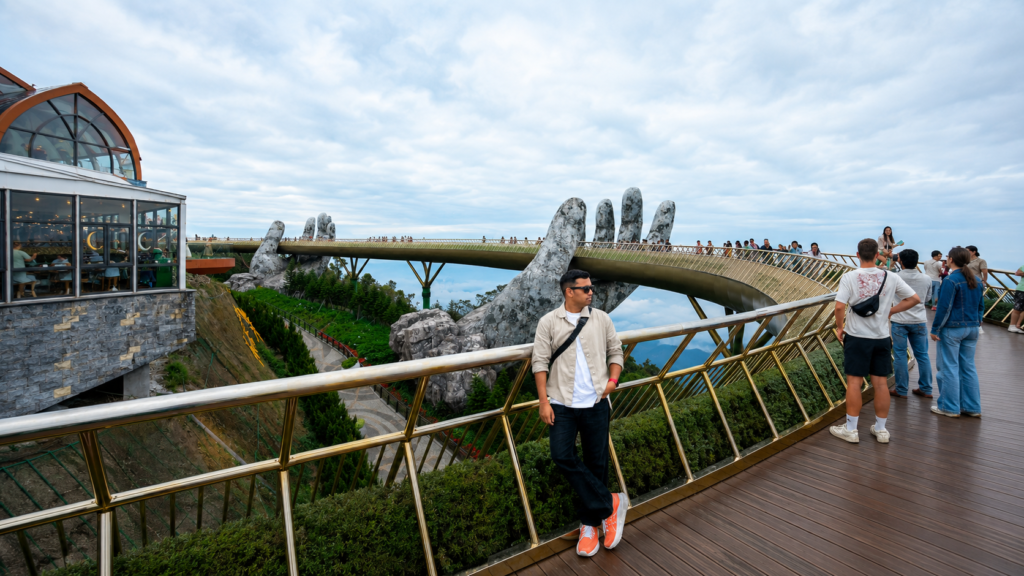
Ba Na Hills is a French colonial-era hill station turned amusement park in the Truong Son mountains, about 25 kilometres west of central Da Nang. French colonists built villas and a wine cellar here in the 1920s to escape the coastal heat, and Sun World took over the site in 2009, adding a cable car system and the Golden Bridge in 2018. The bridge — two enormous stone hands appearing to hold up a gilded walkway — has since become one of the most photographed spots in Vietnam, and Ba Na Hills is consistently ranked among the top places to visit in Da Nang.
The cable car ride alone takes around 20 minutes and climbs to 1,487 metres, weaving through cloud cover that can appear even on clear days at sea level. At the top, the French Village recreates cobblestone streets and a small chapel, while the Fantasy Park section adds rides and an indoor coaster for anyone waiting out the weather.
- Entry Fee: Around 750,000 VND (~$30) for adults, cable car included — check current prices before visiting
- Opening Timings: 7 am–10 pm daily; cable car typically runs 7 am–8:30 pm
- How to Get There: Grab or private transfer from central Da Nang, around 45–60 minutes each way
- Duration: Half-day
Marble Mountains
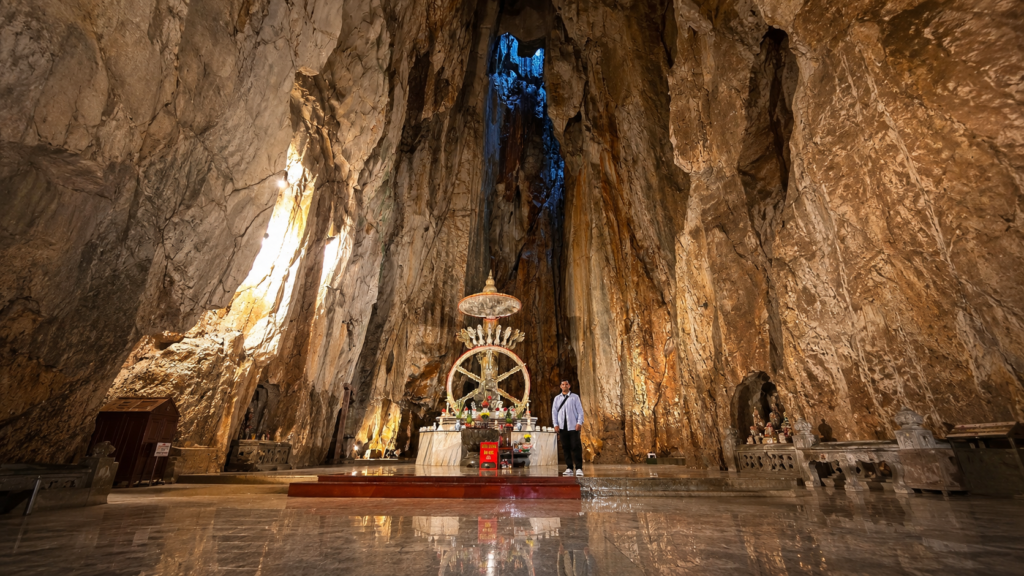
The Marble Mountains are a cluster of five limestone and marble hills a short drive south of My Khe Beach, each named after one of the five elements of Vietnamese cosmology — kim (metal), thuy (water), moc (wood), hoa (fire), and tho (earth). Thuy Son, the tallest and only one open to climbers, holds a network of caves and Buddhist shrines that locals have used as places of worship for centuries, along with the Non Nuoc stone-carving village at its base.
Am Phu Cave, tucked into the mountain’s base, stages a walk-through depiction of Buddhist hell and heaven that’s more unsettling than most temple visits in Vietnam. Steps and a lift both reach the summit, where the coastline and Da Nang’s skyline open up in one view — worth the climb even without the caves.
- Entry Fee: 40,000 VND (~$1.60) for the mountain; separate tickets for Am Phu Cave and the lift
- Opening Timings: 7am–5:30pm daily
- How to Get There: Grab from central Da Nang, around 20–25 minutes
- Duration: 1.5–2 hours
My Khe Beach
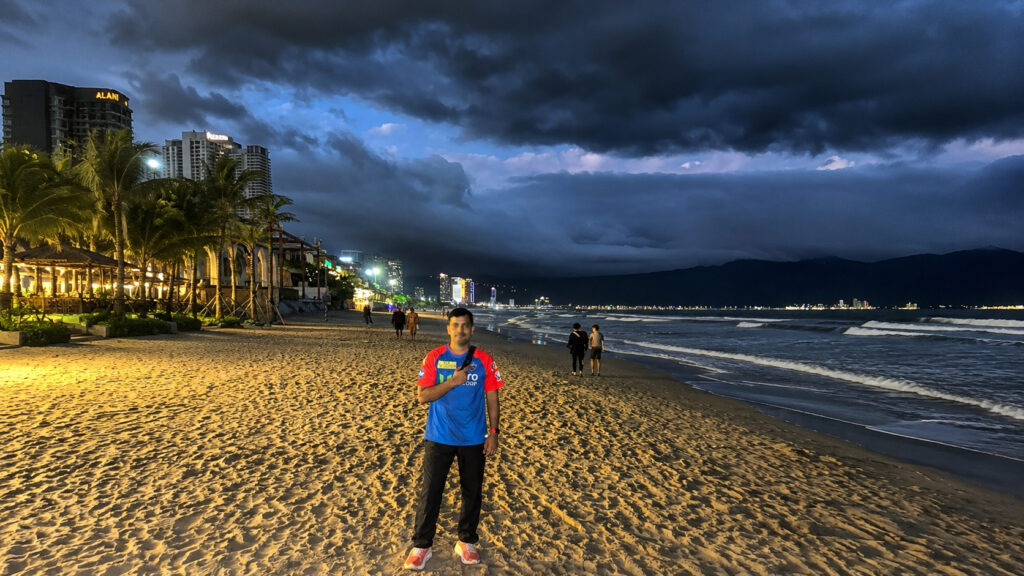
My Khe Beach runs for around ten kilometres along Da Nang’s eastern edge, from the base of Son Tra Peninsula down toward the Marble Mountains. American soldiers stationed here during the Vietnam War nicknamed it China Beach, and the name still appears on some maps and hotel signage. Its fine, pale sand and consistently gentle surf have made it one of the more frequently ranked beaches in Vietnam on international travel lists.
During my time in Da Nang, the beach was busiest in the early morning and again after 5pm, when locals arrive to swim and exercise along the paved path — the middle of the day tends to be quieter and hotter. Sunbeds, umbrella rental, and beachfront cafes are concentrated around the My An and An Thuong areas.
- Entry Fee: Free
- Opening Timings: Open 24 hours; lifeguard-monitored sections typically staffed 6am–6pm
- How to Get There: Walkable from most My An and An Thuong hotels; Grab from Hai Chau, 10–15 minutes
- Duration: 2–3 hours
Dragon Bridge
Dragon Bridge (Cầu Rồng) spans the Han River in the heart of the city, its steel frame shaped into a 568-metre-long dragon that lights up in changing colours after dark. Completed in 2013, it was designed to symbolise Vietnam’s economic development and the country’s mythological dragon lineage. It’s one of six bridges connecting Da Nang’s two halves, but the only one built as a piece of civic sculpture rather than pure infrastructure, and it consistently tops lists of Da Nang tourist attractions for that reason.
On Saturday and Sunday nights at 9pm, the dragon’s head breathes fire and then sprays water toward the crowds gathered along Bach Dang Street. In my experience, arriving at least 20 minutes early is the only way to get a clear sightline before the crowd fills in. On other nights, the bridge is simply a well-lit spot for a riverside walk.
- Entry Fee: Free
- Opening Timings: Open 24 hours; fire-and-water show Fri–Sun at 9pm
- How to Get There: Walkable from most Hai Chau hotels; central riverside location
- Duration: 20–30 minutes
Lady Buddha and Son Tra Peninsula
The Lady Buddha statue stands 67 metres tall on the Son Tra Peninsula, making it the tallest Buddha statue in Vietnam, and forms the centrepiece of the Linh Ung Pagoda complex. Built in 2010, the statue faces out to sea and is visible from much of My Khe Beach on a clear day. The wider peninsula, known locally as Monkey Mountain, is a protected nature reserve home to the endangered red-shanked douc langur.
Past the pagoda, a winding road climbs toward Ban Co Peak, where the coastline and city spread out below — a popular stop for motorbike riders rather than tour buses. Wild macaques are common along the roadside; keep food out of sight, as they’re used to being fed by visitors.
- Entry Fee: Free
- Opening Timings: 6am–6pm daily (Linh Ung Pagoda grounds)
- How to Get There: Grab or motorbike from central Da Nang, around 20–30 minutes
- Duration: 1–1.5 hours
Han Market
Han Market occupies a French colonial-era building on Tran Phu Street and has operated as Da Nang’s main city-centre market since the early 20th century. The ground floor deals mostly in dried seafood, spices, and fresh produce, while the upper level is packed with clothing, souvenirs, and tailoring stalls. It’s smaller and easier to navigate than Ben Thanh Market in Ho Chi Minh City, though the haggling culture is much the same.
Prices aren’t fixed, so expect vendors to open high, especially for anything aimed at tourists — a polite counter-offer is normal practice. Con Market, a short Grab ride away, sees far fewer tourists and is worth a stop for a more local shopping experience.
- Entry Fee: Free to browse
- Opening Timings: 6am–7pm daily
- How to Get There: Walkable from most Hai Chau hotels; on Tran Phu Street by the river
- Duration: 45 minutes
Museum of Cham Sculpture
Built in 1915, the Museum of Cham Sculpture was one of the first museums constructed in Vietnam by the French and holds the world’s largest collection of Cham artefacts. The Cham were an Indianised Hindu civilisation that controlled much of central Vietnam between the 7th and 15th centuries, and the museum’s sandstone carvings — gathered from sites including My Son — are the clearest record of that era still on public display.
The building itself blends French colonial architecture with Cham decorative motifs, and the collection is compact enough to see properly in under an hour — making it an easy pairing with the other central Da Nang attractions nearby, like Han Market and the riverside promenade.
- Entry Fee: 60,000 VND (~$2.40)
- Opening Timings: 7am–5pm daily
- How to Get There: Walkable from Han Market and the riverside; central Hai Chau location
- Duration: 45–60 minutes
Han River Promenade
Bach Dang Street runs along the western bank of the Han River through central Hai Chau, connecting Dragon Bridge to the Han River Bridge — Vietnam’s first swing bridge, built to rotate for passing ships. The paved promenade is one of the few stretches of Da Nang built specifically for walking rather than motorbike traffic, and it doubles as the city’s main vantage point for bridge-watching after dark.
Cafes, rooftop bars, and river cruise docks line the street, and it’s usually busiest in the two hours either side of sunset. The Love Bridge, a smaller pedestrian bridge nearby known for its heart-shaped padlocks, is an easy add-on to the same walk.
- Entry Fee: Free
- Opening Timings: Open 24 hours; liveliest 5pm–10pm
- How to Get There: Central Hai Chau, walkable from Dragon Bridge and Han Market
- Duration: 30–45 minutes
Phap Lam Pagoda
Phap Lam Pagoda was built in 1934 as the headquarters of the Da Nang Buddhist Association and still serves as the administrative base for the city’s Buddhist Sangha today. Renamed from its original title in 1970 and restored in 2009, the two-storey complex sits on Ong Ich Khiem Street in Hai Chau, just three kilometres from the city centre and a short walk from Con Market. At around 3,000 square metres, it’s one of the largest pagoda grounds in Da Nang.
The ground floor holds a lecture hall that seats up to 1,000 people, while the upper floor houses the main worship hall and a large gold Buddha statue flanked by intricately carved pillars. The courtyard’s giant Buddha statues and vegetarian food stalls draw a steady mix of local worshippers and passing tourists, and it’s noticeably quieter than Da Nang’s more visited pagodas.
- Entry Fee: Free (donations welcome)
- Opening Timings: Daily, roughly 6am–8pm; busiest during Tet and other Buddhist festivals
- How to Get There: Grab from central Da Nang, around 10 minutes; walkable from Con Market
- Duration: 30–45 minutes
Things to Do in Da Nang
Han River Night Cruise
Han River night cruises are one of the most-booked things to do in Da Nang, Vietnam, departing from piers along Bach Dang Street after sunset with options ranging from budget group boats to sit-down dinner cruises. Most run for under an hour and follow the same loop past Dragon Bridge, Han River Bridge, and the Love Bridge, all lit up against the water. On Friday, Saturday, and Sunday nights, boats time their route to catch the dragon’s fire-and-water show from the river rather than the crowded riverbank.
I found the earlier evening cruises quieter and better for photos, since the later dinner cruises tend to fill with tour groups. Live music, a short dance performance, and fresh fruit are common inclusions on the group boats, even at the lower price points.
- Price Range: $3–$12 per person
- Duration: 1–3 hours
- Book via: Klook / GetYourGuide
Street Food and Motorbike Tour
Street food tours pair a local guide, often riding pillion on a scooter, with stops at family-run stalls that don’t typically appear in English-language guides. Da Nang’s regional specialty is mi quang, a turmeric-yellow noodle dish topped with shrimp, pork, and roasted peanuts, alongside dishes like banh xeo pancakes and bun cha ca fish-cake soup. Most operators plan four to six stops across a single evening, covering both savoury dishes and dessert.
Riding pillion rather than walking means covering more ground across the city in one sitting, and guides typically order on your behalf so there’s no language barrier at the stall. Some operators ask for your weight in advance to pair you with an appropriately sized driver.
- Price Range: $20–$40 per person
- Duration: 3–4 hours
- Book via: GetYourGuide (also listed on Klook)
Vietnamese Cooking Class
Cooking classes in Da Nang typically begin with a short local market visit before moving to a kitchen for a hands-on session covering four to five dishes. Standard menus include a starter like fresh or fried spring rolls, a salad such as green papaya, and a main like banh xeo or a regional noodle dish. Classes run in small groups, usually with English-speaking instructors.
Expect a printed or digital recipe card to take home, and most classes end with a shared meal of everything just cooked. A Vietnamese coffee-making add-on, covering egg coffee and coconut coffee, is a common upsell worth considering.
- Price Range: $18–$25 per person
- Duration: 2 hours
- Book via: GetYourGuide
Spa and Massage Experience
Spa treatments in Da Nang run noticeably cheaper than equivalent options in Western countries, which has made a massage stop one of the more routine Da Nang activities on a backpacker itinerary rather than an occasional splurge. Options range from simple foot massages to multi-hour packages combining a sauna, steam room, and full-body treatment, with several operators offering hotel pickup as part of the price.
Traditional Vietnamese, Thai-style, and hot stone techniques are all commonly available at the same venues, so it’s worth checking the treatment menu rather than assuming one style. Booking ahead is recommended for evening slots, which fill up quickly.
- Price Range: $8–$25 per person
- Duration: 1–1.5 hours
- Book via: Klook
Hai Van Pass Motorbike Tour
The Hai Van Pass is a 21-kilometre mountain road connecting Da Nang to Hue, made internationally famous after a Top Gear episode filmed the route. A tunnel now carries most through-traffic beneath the mountain, leaving the old pass largely to tourists, motorbike riders, and the occasional local shortcut. Easy Rider-style guided tours cover the full route on the back of a motorbike, usually stopping at a French-built hilltop bunker along the way.
Self-riding is possible for confident, licensed riders, but the road’s hairpin bends and unpredictable weather make a guided pillion ride the safer choice for most visitors. It’s become something of a Da Nang must-do since the road featured on Top Gear, and full-day tours typically continue into Hue itself rather than turning back at the summit.
- Price Range: $35–$70 per person
- Duration: Full day
- Book via: GetYourGuide
Helio Night Market
Helio Night Market sits inside Da Nang’s largest entertainment complex and is one of the more recent additions to the city’s after-dark scene, combining food stalls, a cinema, and play areas for children. Grilled meats, seafood skewers, and the same regional dishes found in the day markets fill the food section, with a dedicated beer and barbecue area drawing a later, louder crowd.
Live music runs most weekend evenings, and the market stays busy well past 10pm — a contrast to the quieter riverside walks earlier in the evening. It’s one of the more reliable answers to what to do in Da Nang after dark.
- Price Range: Free entry (food and drinks paid separately)
- Duration: 1–2 hours
- Book via: Book directly at venue or via local operator
Da Nang earns its growing reputation as more than a stopover between Hanoi and Ho Chi Minh City, combining beach time, mountain scenery, and centuries of layered history within a single, walkable base. Its mix of free attractions — Dragon Bridge, My Khe Beach, Phap Lam Pagoda — and paid experiences like Ba Na Hills or a Hai Van Pass ride means budgets stretch further here than in many of Vietnam’s better-known destinations. Whether the draw is the places to visit in Da Nang or the activities built around them, a few days here rewards travellers who might otherwise treat it as a transit point on the way to Hoi An or Hue. For where to stay while exploring, see our guide to the Best Hostels in Da Nang.
FAQ
Is Da Nang worth visiting, or should I just base myself in Hoi An?
Da Nang is worth two to three nights on its own. It offers beaches, mountains, and city infrastructure Hoi An doesn’t have, while still sitting close enough for an easy day trip or overnight add-on.
How far is Da Nang from Hoi An, and how do I get there?
About 30 kilometres, roughly a 30 to 45 minute drive. Grab taxis, private transfers, and shuttle buses all run the route regularly, and some hotels offer free shuttles for guests.
Do I need warm clothing for Ba Na Hills even though Da Nang is hot?
Yes. Ba Na Hills sits at nearly 1,500 metres, and temperatures there can run noticeably cooler than the coast, sometimes with fog or light rain even on sunny beach days below.
Is Da Nang International Airport close to the city and beaches?
Yes, it’s one of Vietnam’s most central airports, roughly a 10 to 15 minute drive from My Khe Beach and most Hai Chau hotels — far shorter than airport transfers in Hanoi or Ho Chi Minh City.
